UXDG 340 · 2026
oscar
A wearable AI companion that helps museum visitors explore unfamiliar collections without needing a docent.
ROLE
Project Lead, UI & Branding
TIMELINE
10 Weeks
TEAM
4 UX Designers
UI & Branding Lead
UX Design
Product Design
3D Modeling
Wearable AI

THE PROBLEM
Museum galleries hold more context than any single visitor can access.
Museum labels are written for the visitor who already knows what to look for. Everyone else skims a wall of text, half-reads a placard, and moves on without ever getting the story they actually wanted. A docent can fill that gap, but docents don't scale to every visitor on every visit.
THE CONCEPT
A wearable companion that's always on, without ever needing to be opened.
Oscar is worn. A physical device paired with a conversational AI layer, designed to answer questions about a piece the moment curiosity strikes, without pulling a visitor's attention down to a phone screen.
Wearable Device
Worn like a pendant, positioned to listen without ever needing to be held up or aimed at anything.
Conversational Guide
Answers questions about a specific piece in plain language, at whatever depth the visitor asks for.
Personalized Path
Builds a route through the collection based on what a visitor has actually shown interest in.
KEY DECISION
Building a real, physical object to represent the concept honestly.
A semester isn't enough time to build working AI hardware. I had to decide how Oscar would be presented without pretending it did something it didn't.
WHAT I CHOSE
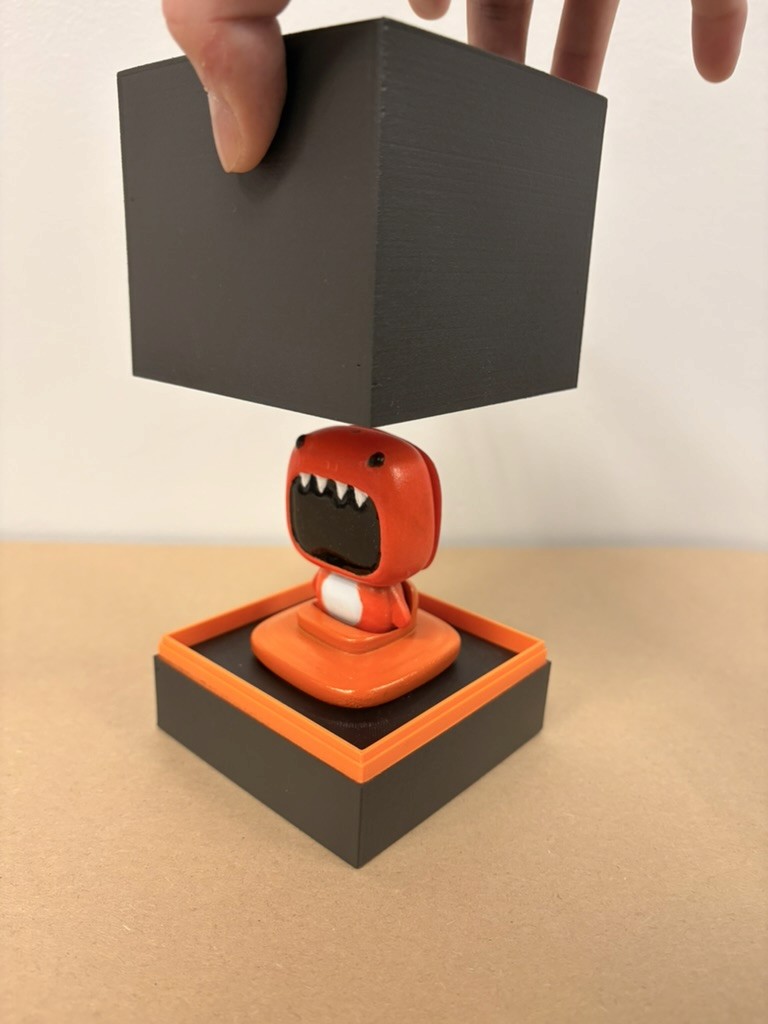
A physical, 3D-printed mockup, built to real scale and presented honestly as a static model.
WHY
A physical object a crit audience can actually pick up and hold says more about form, weight, and wearability than a render ever could, and it doesn't require anyone to take my word for how it would feel.
WHAT I DIDN'T CHOOSE
Building or claiming working electronics, voice AI, or a functioning companion app.
WHY
Faking a working demo is the fastest way to lose credibility the moment someone asks a follow-up question. Presenting Oscar as a concept model, honestly, held up better under scrutiny than a hollow simulation would have.
KEY FEATURES
Designed around the moment curiosity strikes.

HANDS-FREE BY DESIGN
Always on the Body
The physical form factor keeps a visitor's hands and eyes on the artwork. Proximity to a piece triggers the interaction on its own.
CONVERSATION FIRST
Conversation Over Navigation
A visitor just asks, without tapping through menus. The concept treats a question about a painting the same way a knowledgeable friend would answer it, at whatever level of depth the visitor wants.

MEET OSCAR
Object Scanning & Curated AI Responder

Oscar has a name and a personality on purpose. A companion a visitor is willing to talk to needs to feel like something. That's a branding decision as much as an interaction one.
FROM PITCH TO PROTOTYPE
I pitched the concept, then led UI, branding, and the overall project.
Oscar started as my original pitch to the team. From there I served as project lead and UI/branding lead, shaping the visual identity and interaction model while Anthony Chen led 3D modeling, Joaquin Gordillo led physical development, and Hayden White led research.
BEYOND THE OBJECT
A concept that also had to make business sense.
A physical product needs a path to market as much as a working form. We scoped Oscar's business model alongside the device itself: individual, collection, and bulk pricing tiers for museums of different sizes, and a hexagonal charging stand designed to combine into a honeycomb display at checkout, turning the charging station into a piece of the gift-shop experience rather than mere infrastructure.
WHAT SHIPPED
A concept model built and presented honestly.
The team delivered a static 3D-printed physical mockup, a full brand and interaction concept, and a final presentation for crit. There's no working electronics, no functioning AI, and no testing with real museum visitors outside the classroom. That's the honest scope of what exists today.